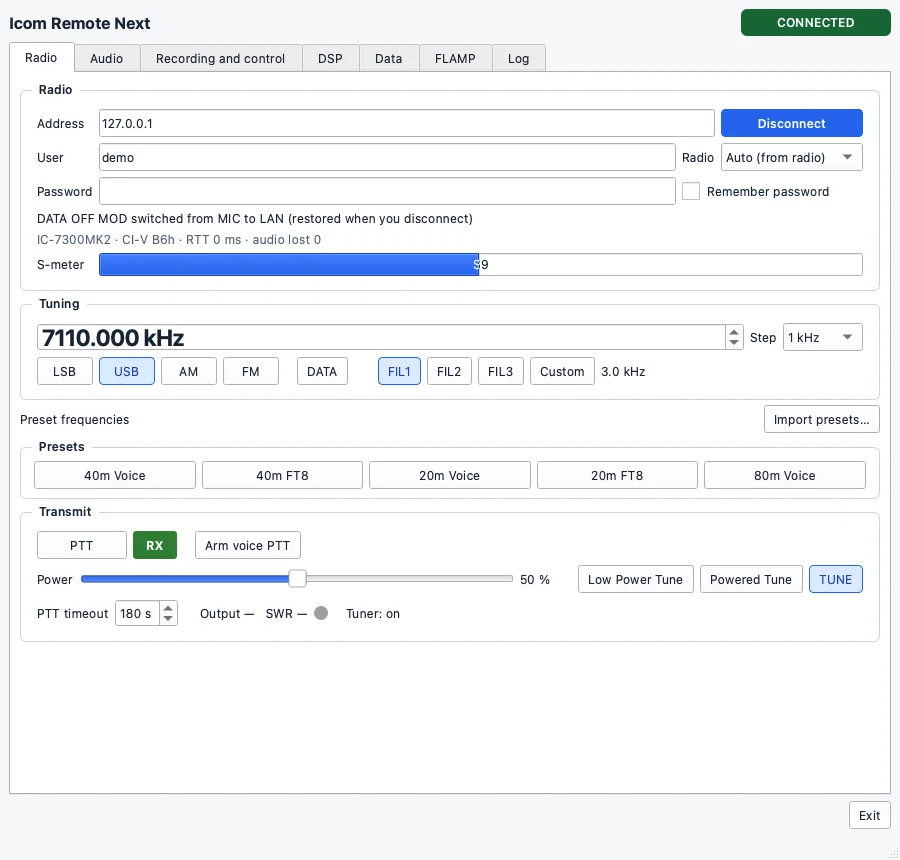
This page covers the
digitalmodesbranch, which has the current features, screenshots and releases (v1.2 at the time of writing). Browse the branch on GitHub.
Icom Remote Next is a Python implementation of Icom’s RS-BA1 network protocol for Windows, macOS and Linux. It builds on the protocol work in kappanhang and wraps it in a desktop interface that connects directly to an IC-7300MK2 or IC-705 over the radio’s built-in LAN or WLAN connection. There is no RS-BA1 software and no PC at the radio.
I use it every day to take part in Air Force MARS nets from remote sites, working both voice and digital traffic through the station’s radio. Switching between remote voice operation and data from a computer at the radio is part of that everyday workflow.
Features
- Control frequency, mode (LSB, USB, AM, FM and the DATA variants), FIL1 to FIL3, RF power and the antenna tuner, with up to 15 frequency presets.
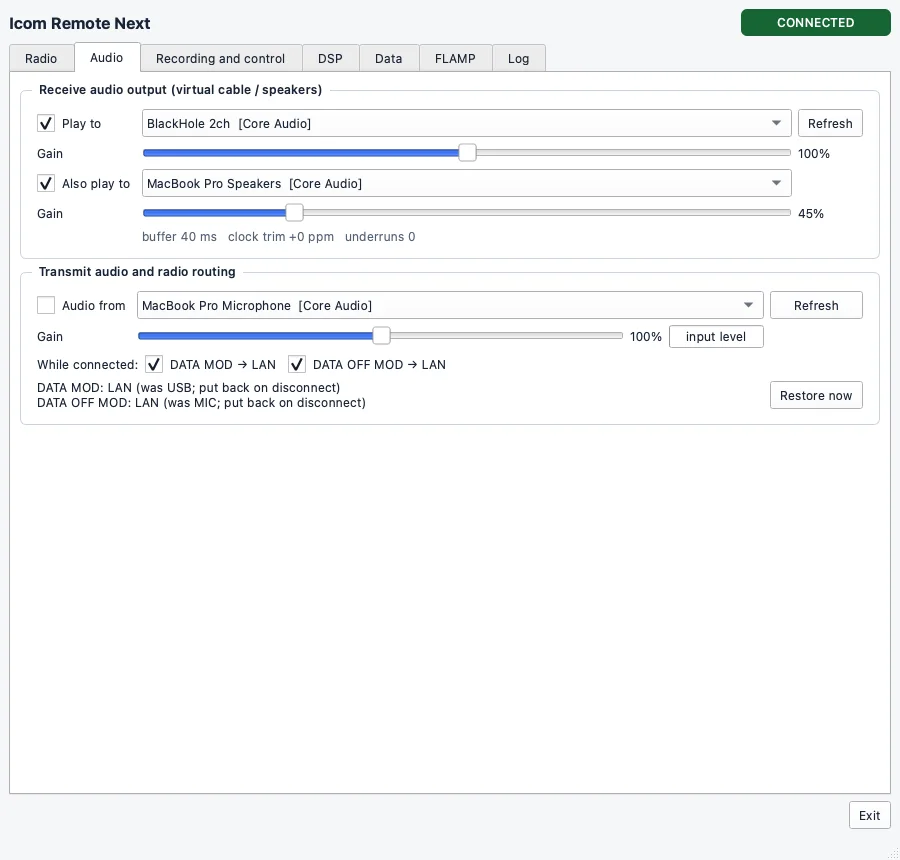
- Two receive outputs at once, each with its own gain and buffering. For example, feed a decoder through a virtual cable and listen on speakers at the same time.
- Transmit voice or data from a microphone or a virtual cable, with armed Space-bar voice PTT and CAT-controlled data PTT.
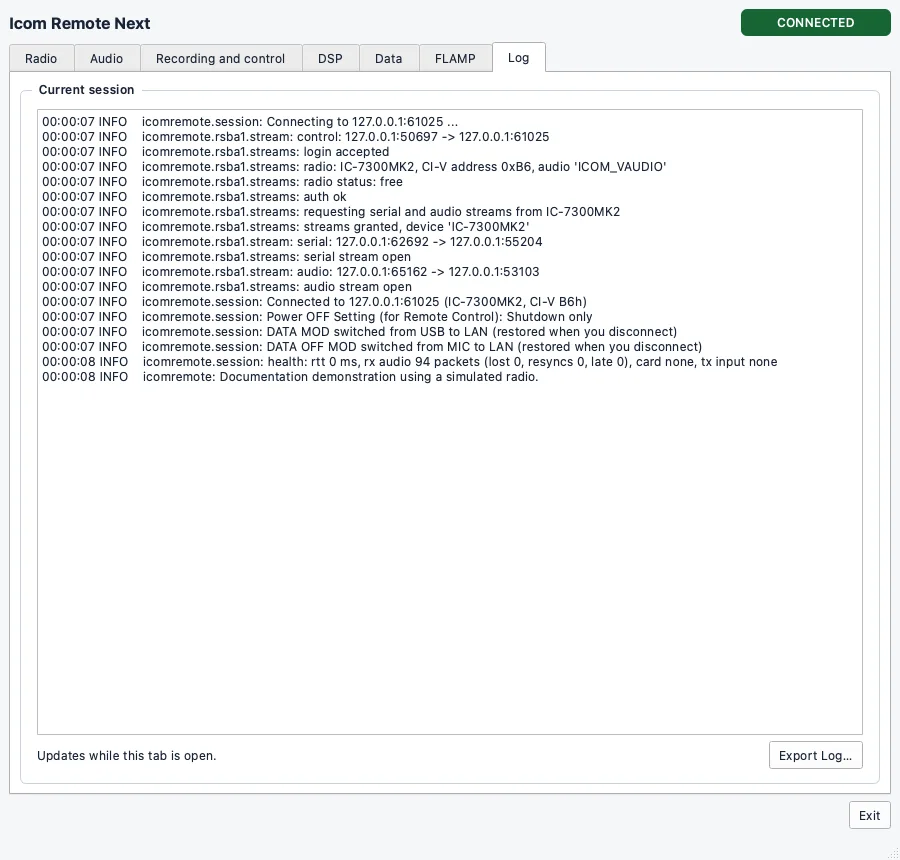
- Switch the transmit source while connected. DATA MOD and DATA OFF MOD move between LAN and local USB with PTT released first, a confirmed readback and tracked restoration.
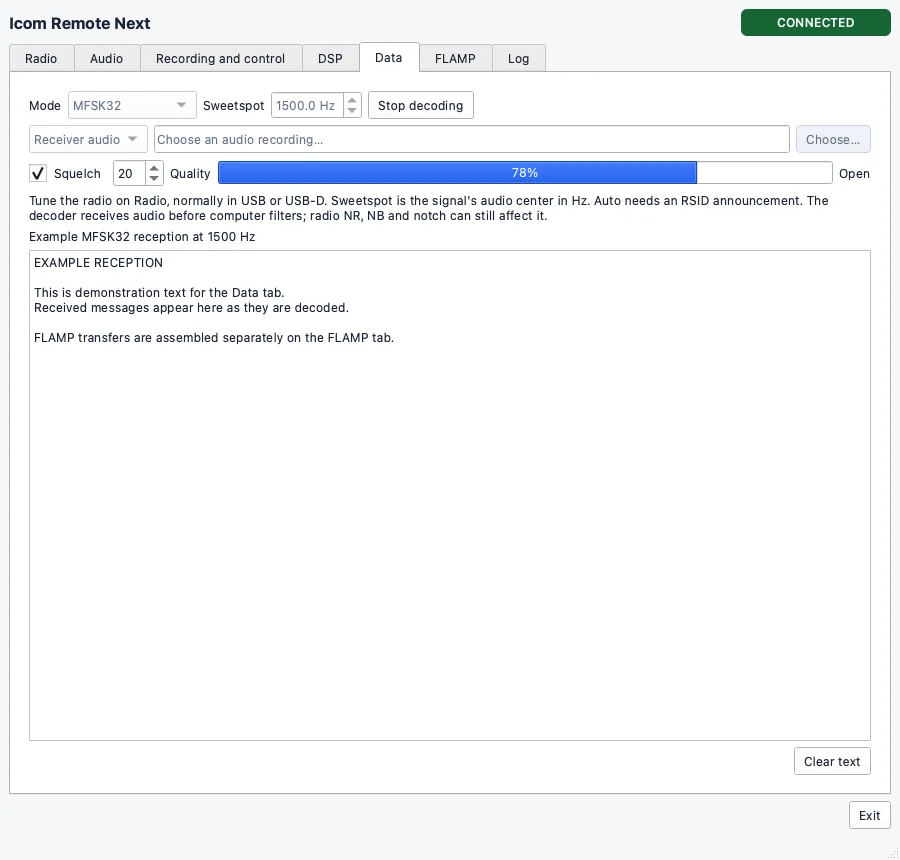
- Decode digital modes in the app: MFSK16, MFSK32, MFSK64 and Contestia 4-250, with RSID auto-detection, adjustable squelch, live receiver audio or saved audio files.
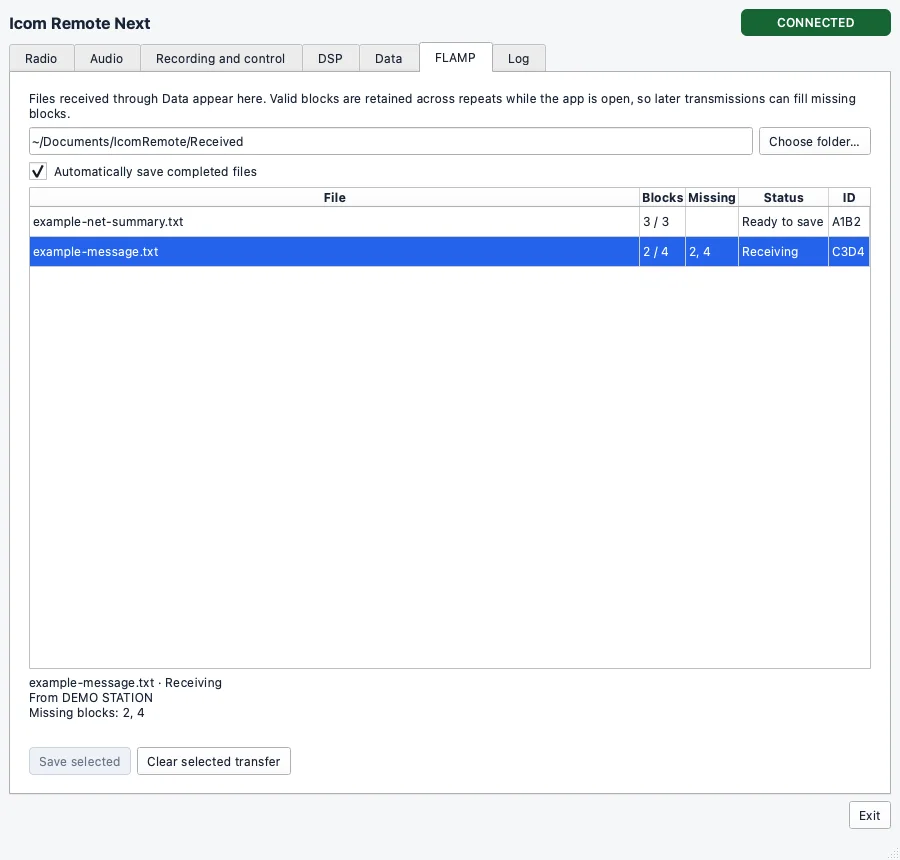
- Receive FLAMP files and messages, retaining valid blocks across repeats and decoder restarts, then saving automatically or on request.
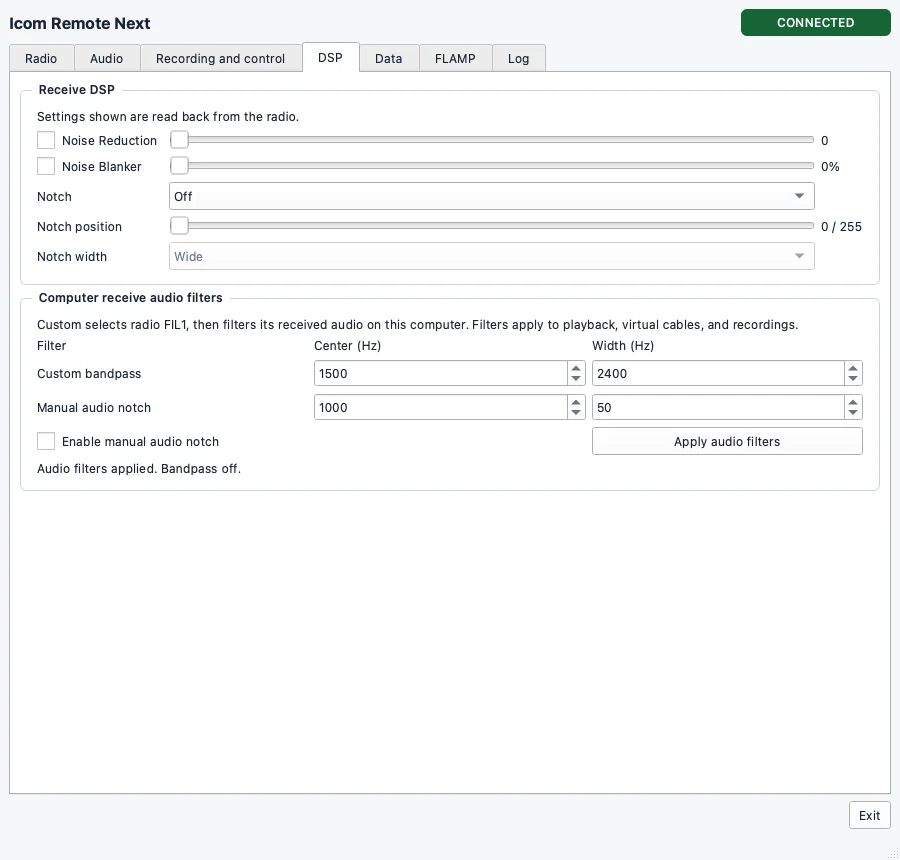
- Filter and tune. IC-7300MK2 noise reduction, noise blanker and notch, plus a computer bandpass and manual notch. Low Power Tune and Powered Tune send a 1 kHz tone to start antenna tuning.
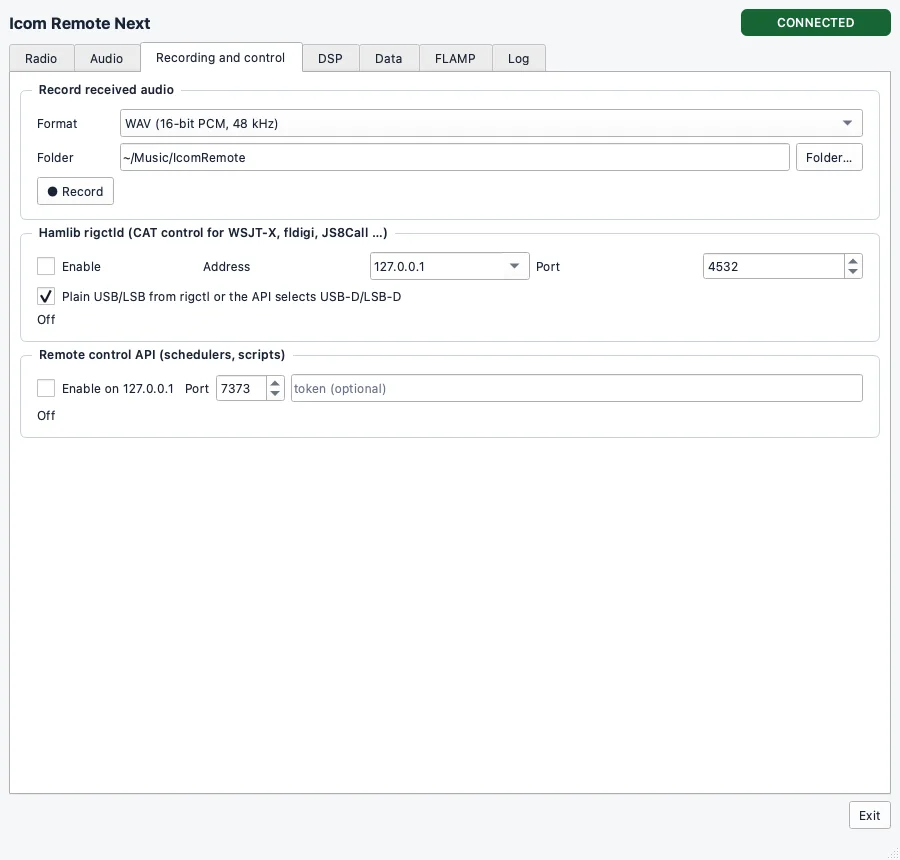
- Record received audio as WAV or AAC in M4A/MP4.
- Integrate through a Hamlib rigctld server (WSJT-X, JTDX, JS8Call, fldigi and MS-DMT), an HTTP API and a console client.
The built-in digital features are receive-only. Programs such as fldigi, WSJT-X or MS-DMT can provide transmit audio and use the client’s rig control.
Built with safety in mind
- Keying is refused unless the DATA state, audio source and input all match. Voice PTT must be armed, starts off at every launch and disarms when the window loses focus, the tab changes, the connection drops or the timeout expires.
- Repeated key-down requests never extend the timeout, and a CAT client’s PTT is released if that client disconnects.
- Audio routes that would feed receive audio back into the transmit input are rejected.
- Modulation settings are written to a restore file first, and recovered at the next connection if the app is killed.
- CAT is loopback-only, and the HTTP API keeps Host and token protections.
The RS-BA1 credential encoding is reversible, so use a trusted network or an encrypted VPN or tunnel when you reach a station remotely.
Supported radios
| Radio | Default CI-V | Status |
|---|---|---|
| IC-7300MK2 | B6h | Primary radio, used daily. Radio DSP and tone-tune controls available. |
| IC-705 | A4h | Owner-confirmed operation. Automatic modulation-source switching uses WLAN. |
| IC-9700 | A2h | Profile and protocol tested with the simulated radio. No antenna-tuner command. |
| IC-7610 | 98h | Profile tested with the simulated radio. Set modulation sources manually on the radio. |
Connection with other RS-BA1 radios is not guaranteed by the Auto profile.
What changed recently
- v1.2: Data and FLAMP tabs with a bundled native decoder, two simultaneous receive outputs, connected DATA MOD and DATA OFF MOD switching, TUNE as a toggle with Low Power and Powered Tune, and a Custom receive filter.
- v1.1: DSP tab, Low Power Tune, 15 presets and a Log tab with export.
- v1.0: an original radio icon and single-file Windows and Linux builds.
How it fits together
IC-7300MK2 or IC-705, over UDP (ports 50001 to 50003), to Icom Remote, which feeds virtual audio cables, rigctld and the built-in decoders for fldigi, WSJT-X, MS-DMT or FLDigi Net Scheduler.
Credits and licensing
GPL-3.0-or-later. The RS-BA1 implementation is based on kappanhang (MIT). The digital reception engine uses fldigi-derived native modem sources, with their GPL and LGPL notices retained in the repository.
Screenshots
Ready to try it?
The install guide covers requirements, downloads, building from source, and first-run setup.